Showing posts with label Networking Concepts. Show all posts

Comparison of Infrared, Radio waves, Microwaves


InfraredRadio WavesMicrowaves
1Infrared is used for short-range communication like TV remotes, mobile phones, personal computers, etc. In science, the Infrared is part of a spectrum that is not visible to the human eyeRadio waves are the  type of wireless communication that can travel large distances as well as can penetrate any wallMicrowaves are a line of sight transmission, meaning both the antennas sending and receiving should be properly aligned. 
2The frequency range of infrared rays 300GHz – 400THzThe frequency range of radio    waves:3KHz – 1GHz. Microwaves have a frequency Range between 1GHz – 300GHz. 
3The limitation of infrared rays is that they cannot penetrate any obstacles and can only use for short-range. Also, Infrared is used in night vision cameras as it has thermal properties. The frequency range of infrared rays 300GHz – 400THzIt can travel large distances as well as can penetrate any wall ( Omni-directional,They are unidirectional, as they can move in only one direction, and therefore it is used in point-to-point communication or unicast communication such as radar and satellite.
4Infrared is one of the secure wireless communication mediums as it is used for short-range. Also, unlike other wireless mediums, infrared is quite inexpensive, and this is some reason it is used in many electronic devices.Radio waves can travel to long distances so it is used for long distance communication and there is no need of digging and spreading wires.Advantages of microwaves then we say that it is a very fast way of communication, that can carry 25000 voice channels at the same time. Also, it is a wireless communication medium so there is no need of digging and spreading wires.
5Infrared waves are used in TV remotes, mobile phones, personal computers Radio waves are used in AM and FM radios, and cordless phones.Microwaves are used in mobile phones communication and television distribution.

Questions for readers :
(Give your answers in the comments section below)

Question 1: Write a short note on Microwaves ?
Question 2: What do you mean by wireless communication. Give examples ?
Question 3: What is the frequency range of Infrared rays Radio waves, Microwave waves ?
Question 4: Write some advantages and disadvantages of Radio waves ?
Question 5: Write some features of wireless communication ?

There is no correct or wrong answers for these questions. So you can give your answers in the comment session below and we will give ours in the next post.

Types of Wireless Communication Media

 We are living in a world, where we can connect with friends within seconds no matter how far they are. But this was not possible in earlier days. We all have heard and read that earlier communication is very tough as sending a letter will require many days and sometimes months. Today is not a case we have different types of medium which can transmit our message very quickly. In this article, we will learn about transmission medium and after wireless communication. Now, what is a transmission medium? Basically, it transmits signals or messages from one computer to another computer. The transmission medium is further divided into two types: Wired or Guided transmission media ( e.g.: Twisted pair cable, Ethernet cable, Coaxial cable, and Optical fiber) and other is wireless or unguided transmission medium (e.g.: Infrared, Radio link, Microwave link, Satellite link, Bluetooth, WIFI ).

In this article, we are more concerned about wireless communication. So, let’s begin understanding wireless communication.

Wireless Communication

Wireless communication is also referred to as Unguided Media or Unbounded transmission media. In this mode, no physical medium is required for the transmission of electromagnetic signals. In wireless communication, we can transfer our message through the air, water or vacuum i.e. Infrared, Radio wave, Microwave wave. So, we don’t worry about the cables or any material to transfer messages, as we can send out a message without and medium.

Wireless communication has advantages and also have disadvantages like it is less secure if we talk about security.

Features

  • No physical medium is required for transmission.
  • It can carry signals through air, water, or vacuum.
  • It can travel large distances but it is also less secure.

Let’s discuss some of its types:-

Infrared

Infrared is used for short-range communication like TV remotes, mobile phones, personal computers etc. In science, the Infrared is part of a spectrum that is not visible to the human eye. The limitation of infrared rays is that they cannot penetrate any obstacles and can only use for short-range. Also, Infrared is used in night vision cameras as it has thermal properties. The frequency range of infrared rays 300GHz – 400THz

Uses:

As we have already have discussed they are used in TV remotes, Pc devices like mice, and keyboards.

Advantage and Disadvantage:

If we talk about the merit part of infrared then we can say Infrared is one of the secure wireless communication mediums as it is used for short-range. Also, unlike other wireless mediums, infrared is quite inexpensive, and this is some reason it is used in many electronic devices.

Now, let’s talk about the disadvantaged part of Infrared waves so they can only be used in short-range communication. Also, they cannot penetrate any obstacles like walls or any building.

Radio Waves

So we have seen the limitation of infrared waves, so here’s another wireless communication that does not have limitations like infrared. Here we are discussing radio waves. that can travel large distances as well as can penetrate any wall ( Omni-directional, these waves can move in all directions). These are easy to generate and can penetrate through buildings. The requirement of radio waves is antennas, sending antennas where one can transmit its message and the other is receiving antennas. The frequency range of radio waves:3KHz – 1GHz. Also, radio waves of frequency 300KHz-30MHz can travel long distances. Moreover, they are   Susceptible to interference meaning they can penetrate any walls.

Uses:

Radio waves are used in AM and FM radios, and cordless phones. Also, some private and government organization reserves certain radio frequencies for direct communication.

Advantage and Disadvantage:

Radio waves have some advantages like they can travel long distances in all directions and can pass through any obstacles, and since they are wireless communication mediums so there is no need of digging and spreading wires. But, yes radio waves have some disadvantages too like radio waves are not effective in bad weather conditions, and they are less secure as they can travel large distances.

Microwaves

Microwaves are a line of sight transmission, meaning both the antennas sending and receiving should be properly aligned. Also, the distance covered by the signal is directly proportional to the height of the antenna. Microwaves have a frequency Range between 1GHz – 300GHz. Basically, we used Microwaves in mobile phones communication and television distribution.

Unlike radio waves, they are unidirectional, as they can move in only one direction, and therefore it is used in point-to-point communication or unicast communication such as radar and satellite.

Uses:

Microwaves are used in mobile phones communication and television distribution.

Advantage and Disadvantage:

If we talk about the advantages of microwaves then we say that it is a very fast way of communication, that can carry 25000 voice channels at the same time. Also, it is a wireless communication medium so there is no need of digging and spreading wires.

Now demerits of microwaves are the first expense, their installation and maintenance are very expensive. that turns this into a very expensive mode of communication. Moreover, Microwaves are also not very effective in bad weather conditions.

Types of Cables used in Wired Communication Media

Twisted pair cable

As the name suggests these are two twisted pairs of cables or wires made up of insulated copper. These are twisted together in such a way that they run parallelly one wire is used for the transmission of data and the other wire is used for ground. Usually, these wires or cables are 1mm in diameter. The twisted-pair cable is made up of 2 copper wires (insulated) arranged in a spiral pattern. Noise interference is more often the problem in these cables but it can be handled by increasing the number of turns per foot of twisted pair cable. 

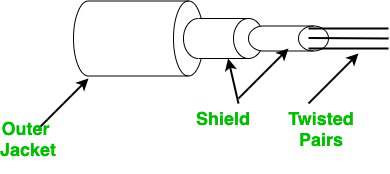
Working of twisted-pair cables: The twisted pair cable has an outer jacket that keeps the wires together, shield for protection of cable, and color-coded plastic insulation to uniquely identify each conductor, and twisting of wires to cancel the electromagnetic waves that create noise interferences during the transmission of data. When current flows through the cable then a small circular magnetic field is created around the wire. For the connection between two devices connectors are needed at both ends like RJ45 for computer connection.

Types of Twisted pair cables are:-

  • Unshielded Twisted pair (UTP)
  • Shielded Twisted pair (STP)

Unshielded Twisted pair (UTP)

UTP cables are the most common twisted pair cables that are used in computer networks as well as in telecommunication. These cables are made up of 4 color-coded copper wires twisted together to cancel the disturbances from outer sources and the electromagnetic interference. There are different categories of UTP cables used for telecommunication and other purposes. For example, some are used for telephone line services with good speed and some offer 4mbps to 16mbps speed some provide 20mbps speed and it is enough for communication for longer distances.

Connectors: The most common UTP connector is RJ45 (Here, RJ stands for registered jack), (There are two types RJ45 male and RJ45 female cable). RJ45 is a keyed connector, which means that the connector can be connected in only one way. Its cables are mostly used on an ethernet connection. For example, Computers, Modems, Printers, and various network storage devices.

Merits

  • These cables are cheaper.
  • The maintenance cost is low.
  • It doesn’t require any ground wire.

Demerits

  • The transmission rate of data is slow.
  • Noise is high in these cables.

Shielded Twisted pair cables (STP)

In comparison with UTP’s Shielded twisted pair cables are costlier and consist of metal foil sometimes made up of insulated conductors. Metal foils help to improve the quality of the wire which otherwise will be affected by noise. These cables are used to reduce crosstalk and the interference caused due to electromagnetic waves. The company that first introduced these STP cables was IBM. These cables are used for both Analog and digital transmissions.

Merits

  • The transmission rate of data is fast.
  • Noise is slow in these cables.

Demerits

  • These cables are costlier.
  • The maintenance cost is higher.
  • It requires ground wire.

Applications 

Some applications of Twisted pair cables:

  1. Telephone systems: To provide voice and data channels.
  2. LANs use twisted-pair cables.
  3. The DSL lines used by the telephone companies also use the unshielded twisted pair cables to provide extremely high data rate connections.

Co-axial cable

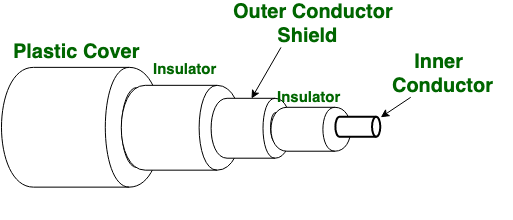
The most common type of transmission media that is used in various applications like tv wires and ethernet connection setup also. This is a form of transmission media that consists of two conductors kept in parallel to each other. It has a central core conductor of a solid copper wire enclosed in an insulating sheet and the middle core conductor is made up of copper mesh and lastly an outer metallic wrap that helps in noise cancellation. The whole cable is covered and protected by a plastic cover.

It is considered better than twisted-pair cables because of the higher frequency range. Coaxial cables are best suited for shorter distances as there are higher chances of data loss in more distances for that fibre optic cables are best as fibers are capable of higher data transfer and with greater speed as compared to coaxial cables. Cost and maintenance are also less, unlike fiber optic cables. And durability these cables are more. 

The various types of coaxial cables:

  1. Triaxial Coaxial Cable
  2. RG-49Coaxial Cable
  3. RG-11 Coaxial Cable
  4. RG-6Coaxial Cable
  5. Hardline cable
  6. Rigid Coaxial Cable
  7. Semi-Rigid Coaxial Cable
  8. Formable Coaxial Cable
  9. Flexible Coaxial Cable

Working of Coaxial Cables: Coaxial cables are made up of copper wires for carrying the higher frequency signals this wire is covered with an insulated foil cover whenever current flows it maintains a constant distance between the conductor and the next layer and then a shielded wire that prevents the interference of noise in between the transmission and at last the plastic cover that protects the whole cable from any outer disturbances. Hence, a coaxial cable carries a signal in a way that when the current enters the centre copper wire as well as the metal shield. The metal conductors at that point generate a magnetic field. The insulators help the signals not to come in contact with each other, they also the signal from outside magnetic fields. In this way, the signal is carried over larger distances without much loss.

Coaxial Cable Standards: These cables are categorized by their radio government (RG) ratings and each RG number denotes a unique set of physical specifications. Example, 

RG-59        75 ohm           Cable TV

RG-58        50 ohm           Thin Ethernet

Application

Some applications of Coaxial cables:

  1. Digital telephone networks
  2. Analog telephone networks
  3. Cable TV networks
  4. Ethernet LANs

Merits

  • The cost of coaxial cables is less as compared to fibre optic cables.
  • It has a higher data transmission rate.
  • It can be used in both analog and digital transmissions.
  • Higher frequency applications can use coaxial cables for better performance.

Demerits

  • For long distances, the cost of these cables will be higher.
  • The size of these cables is usually bulky because of various layers of metal as well as copper and plastic.
  • The data transmission in long distances is poor.

Fiber-optic cables

Also known as optic fiber cables are highly efficient and advanced data transmission cables that allow the transfer of data in a very large volume. Fiber optic cables allow data transmission with the help of electrical signals. These are thin pipes made up of glass or plastic known as optic fibers and data or information flows via light in these cables. With higher bandwidth and high-quality performance optic fiber cables are best suited for long-distance data transfer and communication.

Types of Fibre-Optic Cables;

  • Single-mode Fibres: It is capable of one way transmission with a rate of almost 50 times more than multimode fibres. Used in small scale companies and in local area networks also.
  • Multimode Fibres: It has higher bandwidth and cable of two-way transmission capable of higher data transmission. Used in local area networks, corporate sectors and private networks also.

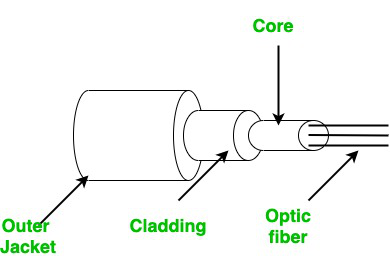
Working of fiber-optic cable: Fiber optic cables carry information via light so at the transmitting side the light source is first encoded with data or information and then the data starts flowing in the core of the fiber optic cable in a complete bouncing manner with a complete internal reflection then there is cladding that helps the light to remain inside the cable after reaching the receiver side the data is then decoded like the original. So basically fiber optic is a form of transmission media for the transfer of data via light with higher bandwidth and a higher rate of transmission.

It consists of five major parts named as: core, Cladding, Coating, Strengthening, and Outer jacket.

Here, Core is a thin part of the glass of the optic fibre cable and cladding is the insulation around the core and coating is the protective layer for optical fibre and the strengthening part allows protection to the core and at last outer jacket for the whole optic fibre tube.

Application 

Some applications of Fibre-optic cables.

  • One of the most popular and important uses of Fibre -optic cables is the INTERNET.
  • Television broadcasting These cables are very much suitable for transmitting signals for high-definition televisions because of their greater bandwidth and speed.
  • Surgical operations in medical these cables are used in various fields of medicine and research purposes as their cost is low as compared to other cables.
  • It is used in industries and in defence services also these cables are of great use.

Merits

  • Long durability: These have long durability of almost 100 years.
  • Low cost: Due to the cheaper cost these cables are in high demand usually of more use.
  • Greater bandwidth and speed: Higher speed and great bandwidth help in faster and even smoother data transmission.
  • Light signals: In the same fiber cable light signals of one fiber and the other do not interfere with each other which is not in the case of other cables.

Demerits

  • Delicacy: Fibre-optic cables are more delicate as compared with copper wires. If bent too much these cables can be damaged easily.
  • Installation Cost: The installation process is cost-effective as it requires machines and specialists team for the setup of the fiber cables.
  • Low power: Since data flows via light in these cables power supply is limited, and for high power emitters cost would be more.

Communication Channels

 Communication channels are the medium that connects two or more workstations. Workstations can be connected by either wired media or wireless media. It is also known as a transmission medium. The transmission medium or channel is a link that carries messages between two or more devices. We can group the communication media into two categories:

  • Guided media transmission
  • Unguided media transmission

1. Guided Media:  In this transmission medium, the physical link is created using wires or cables between two or more computers or devices, and then the data is transmitted using these cables in terms of signals. Guided media transmission of the following types:

1. Twisted pair cable: It is the most common form of wire used in communication. In a twisted-pair cable, two identical wires are wrapped together in a double helix. The twisting of the wire reduces the crosstalk. It is known as the leaking of a signal from one wire to another due to which signal can corrupt and can cause network errors. The twisting protects the wire from internal crosstalk as well as external forms of signal interference. Types of Twisted Pair Cable :

  • Unshielded Twisted Pair (UTP): It is used in computers and telephones widely. As the name suggests, there is no external shielding so it does not protects from external interference. It is cheaper than STP.
  • Shielded Twisted Pair (STP): It offers greater protection from crosstalk due to shield. Due to shielding, it protects from external interference. It is heavier and costlier as compare to UTP. 

2. Coaxial Cable: It consists of a solid wire core that is surrounded by one or more foil or wire shields. The inner core of the coaxial cable carries the signal and the outer shield provides the ground. It is widely used for television signals and also used by large corporations in building security systems. Data transmission of this cable is better but expensive as compared to twisted pair.

3. Optical fibers: Optical fiber is an important technology. It transmits large amounts of data at very high speeds due to which it is widely used in internet cables. It carries data as a light that travels inside a thin glass fiber. The fiber optic cable is made up of three pieces:

  1. Core: Core is the piece through which light travels. It is generally created using glass or plastic.
  2. Cladding: It is the covering of the core and reflects the light back to the core.
  3. Sheath: It is the protective covering that protects fiber cable from the environment.

2. Unguided MediaThe unguided transmission media is a transmission mode in which the signals are propagated from one device to another device wirelessly. Signals can wave through the air, water, or vacuum. It is generally used to transmit signals in all directions. Unguided Media is further divided into various  parts :

1. Microwave: Microwave offers communication without the use of cables. Microwave signals are just like radio and television signals. It is used in long-distance communication. Microwave transmission consists of a transmitter, receiver, and atmosphere. In microwave communication, there are parabolic antennas that are mounted on the towers to send a beam to another antenna. The higher the tower, the greater the range.

2. Radio wave: When communication is carried out by radio frequencies, then it is termed radio waves transmission. It offers mobility. It is consists of the transmitter and the receiver. Both use antennas to radiate and capture the radio signal.

3. Infrared: It is short-distance communication and can pass through any object. It is generally used in TV remotes, wireless mouse, etc.

Types of data communication

 As we know that data communication is communication in which we can send or receive data from one device to another. The data communication is divided into three types:

  1. Simplex Communication: It is one-way communication or we can say that unidirectional communication in which one device only receives and another device only sends data and devices uses their entire capacity in transmission. For example, IoT, entering data using a keyboard, listing music using a speaker, etc.
  2. Half Duplex communication: It is a two-way communication or we can say that it is a bidirectional communication in which both the devices can send and receive data but not at the same time. When one device is sending data then another device is only receiving and vice-versa. For example, walkie-talkie. 
  3. Full-duplex communication: It is a two-way communication or we can say that it is a bidirectional communication in which both the devices can send and receive data at the same time. For example, mobile phones, landlines, etc.

Components of Data Communication

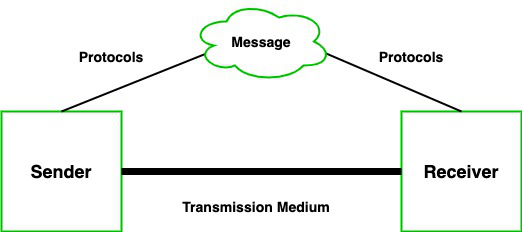
 A communication system is made up of the following components:

  1. Message: A message is a piece of information that is to be transmitted from one person to another. It could be a text file, an audio file, a video file, etc.
  2. Sender: It is simply a device that sends data messages. It can be a computer, mobile, telephone, laptop, video camera, or workstation, etc.
  3. Receiver: It is a device that receives messages. It can be a computer, telephone mobile, workstation, etc.
  4. Transmission Medium / Communication Channels: Communication channels are the medium that connect two or more workstations. Workstations can be connected by either wired media or wireless media.
  5. Set of rules (Protocol): When someone sends the data (The sender), it should be understandable to the receiver also otherwise it is meaningless. For example, A sends a message to B. If A writes in Hindi and B cannot understand Hindi, it is a meaningless conversation.

Therefore, there are some set of rules (protocols) that is followed by every computer connected to the internet and they are:

  • TCP(Transmission Control Protocol): It is responsible for dividing messages into packets on the source computer and reassembling the received packet at the destination or recipient computer. It also makes sure that the packets have the information about the source of the message data, the destination of the message data, the sequence in which the message data should be re-assembled, and checks if the message has been sent correctly to the specific destination.
  • IP(Internet Protocol): Do You ever wonder how does computer determine which packet belongs to which device. What happens if the message you sent to your friend is received by your father? Scary Right. Well! IP is responsible for handling the address of the destination computer so that each packet is sent to its proper destination. 

About Cloud Computing

 A physical site called a data center houses a common pool of computer resources (such as hardware, software, and services like servers and internet storage). Your cloud service providers have data centers all around the world.

Cloud computing is a methodology for providing on-demand network access to a shared pool of programmable computing resources that can be quickly supplied and released with no administration effort or service provider contact.
Cloud computing is an internet-based computing model in which several network connections and computer systems are used to provide online services. Users at a distance who have access to the internet can readily access the cloud and its services, and these services and information can be shared among several computers and users if they are all linked.

Types of Clouds

The four types of access to the cloud are public, private, hybrid, and community:

(a) Public Cloud: The public cloud makes it possible for anybody to access systems and services. Because of its openness, the public cloud may be less secure. The public cloud is one in which cloud infrastructure services are made available through the internet to the public or large industrial groups. The infrastructure in this cloud model is owned by the company that delivers the cloud service, not by the consumer.
Example: Microsoft Azure, Google App Engine

(b) Private Cloud: A private cloud is one in which cloud infrastructure is set aside for a single organization’s exclusive use. Organizations, third parties, or a mixture of both own, manage and operate it. In this architecture, the cloud infrastructure is provisioned on the organization’s premises but hosted in a third-party data center. Organizations will benefit from the private cloud over public cloud since it gives them more flexibility and control over cloud resources. Example: E-bay

(c) Hybrid Cloud: Hybrid cloud, as the name implies, is a blend of different cloud models, such as public cloud, private cloud, and community cloud. This model utilizes all the models that are a component of it. As a result, it will combine scalability, economic efficiency, and data security into a single model. The complexity of creating such a storage solution is a downside of this strategy.

(d) Community Cloud: The community cloud model distributes cloud infrastructure among numerous organizations to support a specific community with shared issues. Cloud infrastructure is delivered on-premises or at a third-party data center in this manner. Participating organizations or a third party manage this.

Wired / Wireless Networking

 On basis of physical medium, there are 2 types of networks:

(a) Wired Network: As we all know, “wired” refers to any physical medium made up of cables. Copper wire, twisted pair, or fiber optic cables are all options. A wired network employs wires to link devices to the Internet or another network, such as laptops or desktop PCs.

(b) Wireless Network: “Wireless” means without wire, media that is made up of electromagnetic waves (EM Waves) or infrared waves. Antennas or sensors will be present on all wireless devices. Cellular phones, wireless sensors, TV remotes, satellite disc receivers, and laptops with WLAN cards are all examples of wireless devices. For data or voice communication, a wireless network uses radiofrequency waves rather than wires.

Types of Networks

(a) Wi-Fi

The industry-standard wireless local area network (WLAN) technology for linking computers and other electronic devices to one another and the Internet. Wi-Fi is a wireless variant of a wired Ethernet network that is frequently used in conjunction with it (see Ethernet). 
WiFi is a type of wireless networking that uses radio frequencies to send and receive data. WiFi allows users to connect to the Internet at high speeds without the necessity of cables. WiFi stands for “wireless fidelity” and is a phrase that is often used to refer to wireless networking technologies. A wireless router is used to connect to the internet. When you connect to Wi-Fi, you’re connecting to a wireless router that connects your Wi-Fi-enabled devices to the Internet.

(b) Bluetooth

Bluetooth is a telecommunication industry standard that outlines how mobile devices, PCs, and other equipment can communicate wirelessly across short distances. This wireless technology allows Bluetooth-enabled devices to communicate with one another. It connects desktop and laptop computers, PDAs (such as the Palm Pilot or Handspring Visor), digital cameras, scanners, cellular phones, and printers over short distances.

Infrared used to serve the same purpose as Bluetooth, but it had a few disadvantages. If an object were to be placed between the two communication devices, for example, the communication would be disrupted. (If you’ve ever used a television remote control, you’ve probably observed this limitation.) The infrared transmission was very slow, and devices were frequently incompatible with one another.

Because Bluetooth technology is based on radio waves, items or even walls can be placed between communication devices without disrupting the connection. Bluetooth also employs a common 2.4 GHz frequency, ensuring that all Bluetooth-enabled devices are interoperable. The sole disadvantage of Bluetooth is that its range is restricted to 30 feet due to its high frequency.

Bluetooth is a computer and telecommunications industry standard that defines how devices connect with one another. Computers, computer keyboards and mice, personal digital assistants, and cellphones are all Bluetooth-enabled devices. Bluetooth consumes less energy and is less expensive to set up than Wi-Fi. Because of its lower power, it is less likely to suffer from or cause interference with other wireless devices operating in the same 2.4GHz radio band.

A Short Brief About World Wide Web

 The World Wide Web (WWW) is an internet-based service that distributes documents across the Internet using a standard set of rules known as Protocols.

It is the Internet’s most popular information retrieval service (the worldwide computer network). Hypertext or hypermedia links—i.e., electronic connections that link similar bits of information to offer a user quick access to them—provide users with access to a huge array of documents that are connected to each other over the Web.

The World Wide Web (www) is a collection of web servers that use hyperlinks to move between websites using a program called a web browser, making the Internet accessible and available to everyone, anywhere, at any time. It is a document creation, organizing, and linking system. 

A Uniform Resource Locator (URL) is an Internet address given to a web page (URL). A website is a collection of online pages that belong to a given URL, such as www.geeksforgeeks.com, www.google.com, and so on. As a result, the World Wide Web functions as a massive electronic book, with pages stored on many servers throughout the world.

 Solution for Question 1:

Advantages of internet are,

  • Source of entertainment – Online gaming, talking, browsing, music, movies, dramas, and TV series are quickly becoming the most popular ways to pass the time.
  • Source of information – There is no better place to conduct research than the internet. We can learn about the latest trends, communicate with experts without having to physically visit them, and seek professional advice over the internet.
  • E – Commerce – With the advancement of internet technology, large online E-commerce enterprises such as Amazon, Ali Baba, myntra etc. have emerged.
  • Working from home, collaborating with others, and having access to a global workforce are all advantages.
  • Keeps Updated – Because there are hundreds of thousands of newsgroups and services that keep you updated with every tick of the clock, the Internet is a source of the most recent news.

Disadvantages of internet are,

  • Time Wastage – Most people believe that spending too much time on the internet is unhealthy for young people and leads to obesity. 
  • Money Laundering – Aside from reputable sites, there are some Social Media Advertising sites that try to steal your personal information, credit card information, and even your pin code. You can easily become a victim of money scam if they get this information.
  • Exposure to private data – It is now quite easy to decipher someone’s chat or email communication thanks to the hacking community. As we all know, data is transmitted in packets, which hackers can simply detect and reconstruct.
  • Harassment & threatening – Bullies exist online, just as they do in real life, and they can lower your self-esteem by harassing and threatening you. Some of these individuals may be persons who are aware of some of your personal details and dislike you, and may use this information to harass you.

Solution for Question 2:

We can connect to the internet in the following ways:

  • Dial-Up – In order to access the Internet, in this type of connection, users must connect their phone line to a computer . This link prevents the user from using tier home phone service to make or receive calls.
  • Broadband – Broadband is a high-speed internet connection that is frequently utilized nowadays and is provided by cable or phone companies.
  • Wireless connections – Internet access is accomplished by radio waves, thus it is possible to connect to the Internet from any location. Wi-Fi and mobile service providers are examples of wireless connections. 

Solution for Question 3:

Sir Tim Berners-Lee is credited with creating the World Wide Web. He came up with the core idea for the WWW while working at the European Organization for Nuclear Research in 1989. He wanted to combine the growing technologies of computers, data networks, and hypertext into a powerful and easy-to-use worldwide information system.

The Internet is a vast network of networks that functions as a networking infrastructure. It links millions of computers throughout the world, creating a network in which any computer can talk with any other computer as long as they are both linked to the Internet. The World Wide Web, or simply Web, is a method of gaining access to information over the Internet.

The World Wide Web, also known as the ‘www,’ is a collection of webpages that can be quickly published on the Internet and read by millions of people. 

Solution for Question 4:

The full form of www is World Wide Web. It is the world’s most dominant software and is commonly known as the web.

Solution for Question 5:

Serial numberNetworkInternet
1.A network is a collection of two or more computer systems.The internet, on the other hand, is the interconnection of a few networks.
2. Low hardware devices required as compared to internet. More hardware devices required as compared to network.
3. Geographically constrained (small – area wise)Geographically extensive (large – area wise)
4.As cover small area, low error rateAs covers large area, higher error rate
5. Lower communication costHigh communication cost